


Greece Peak Season 2026: Same Constraints, Tighter Execution Required

For more detailed information on specific destinations and regulations within Greece, please visit our articles on:
Parking remains extremely limited across Greece heading into summer 2026, and it continues to drive most operational risk.
The constraints themselves are familiar. What changes is how quickly options disappear once demand builds.
“The biggest misconception is that conditions are getting worse,” says Dimitra Kiriakopoulou, Ops & Customer Care Director, Universal Aviation Greece. “In reality, the constraints are very similar year over year. What’s changed is how little flexibility remains once peak demand sets in.”
Why does Greece get difficult in summer?
 The airports are open. Getting in usually isn’t the issue.
Parking is tight at most island airports, and weekend demand reduces availability quickly. Once it does, options disappear fast. Visible ramp space does not mean parking availability.
Once schedules are set, making changes becomes difficult.
The challenge isn’t access. It’s controlling where the aircraft can stay and for how long.
What’s actually different in 2026?
Very little.
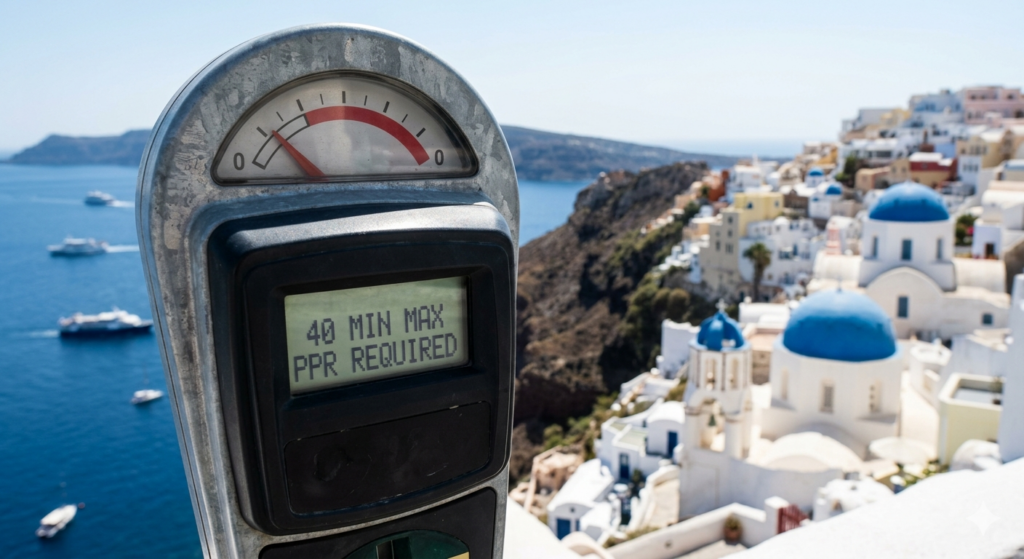
Santorini (LGSR) has one change worth noting. The 40-minute parking limit between 0500–1800Z remains, but overnight stays of up to 11 hours are now possible outside that window. This helps in specific scenarios but does not change the overall parking situation across Greece.
Slots are also largely unchanged, with one exception. Athens (LGAV) moves to Level 3 coordination from September 17–22. During that period, slot adherence becomes critical and schedule flexibility is limited.
Peak season pressure runs May 15 through September 15, with the heaviest demand concentrated on weekends.
Where does planning fall apart?
Usually in the same place. Operators wait too long to commit to an alternate.
“The pattern is always the same,” Kiriakopoulou says. “Operators try to secure their preferred location first, and only look at alternates after. By then, availability is already gone.”
Operators often don’t realize how quickly availability disappears once weekend demand hits.
From there, the sequence is predictable. Preferred parking is not confirmed. No alternate is secured. Availability disappears across the network. Crews are left trying to reposition with limited or no viable options.
Slot management issues add to the problem. Holding multiple bookings without proper cancellation, or misaligning slots across destinations, leads to penalties, fines, or operational conflicts.
Crew logistics are a common planning mistake. Aircraft parked on one island while accommodations are arranged on another adds unnecessary complexity in an already constrained environment.
“Most issues we see aren’t because access is denied,” Kiriakopoulou says. “They happen because planning decisions were made too late, or without full alignment.”
Fuel and ground handling
Not a limiting factor right now.
Fuel supply in Greece remains stable despite concerns in other parts of Europe, though the situation continues to be monitored. Ground handling conditions are also steady, with no significant changes reported.
What does good planning look like?

Success depends on committing early to workable parking, not chasing preferred locations.
Secure a confirmed alternate from the start. Build the schedule around where the aircraft can actually stay. Manage slots carefully and keep aircraft, crew, and accommodations aligned.
“Parking rarely improves closer to the operation,” Kiriakopoulou says. “If anything, options narrow. The operators who commit early are the ones who avoid disruption.”