


Global Health Screening and Disinsection Requirements Affecting International Flight Operations

Most operators think about public-health procedures when an outbreak is in the news. The procedures that create the most operational problems are the ones that were already in place before anyone started paying attention.
Aircraft disinsection requirements, vector-control programs, passenger screening protocols, and biosecurity enforcement measures affect international business aviation year-round. They vary by country, by airport, by season, and sometimes by the individual authority conducting the inspection. They may change with little notice. And they are often absent from standard preflight planning assumptions.
The recent Ebola screening framework is one example of how quickly a public-health situation can become an operational aviation problem. But the broader compliance environment exists independent of any single outbreak. Operators planning missions into affected regions should also review our Ebola operational update.
For operators, the challenge is rarely the existence of the restriction. It is identifying which procedures apply before the mission is built.
Aircraft Disinsection and Vector-Control Procedures
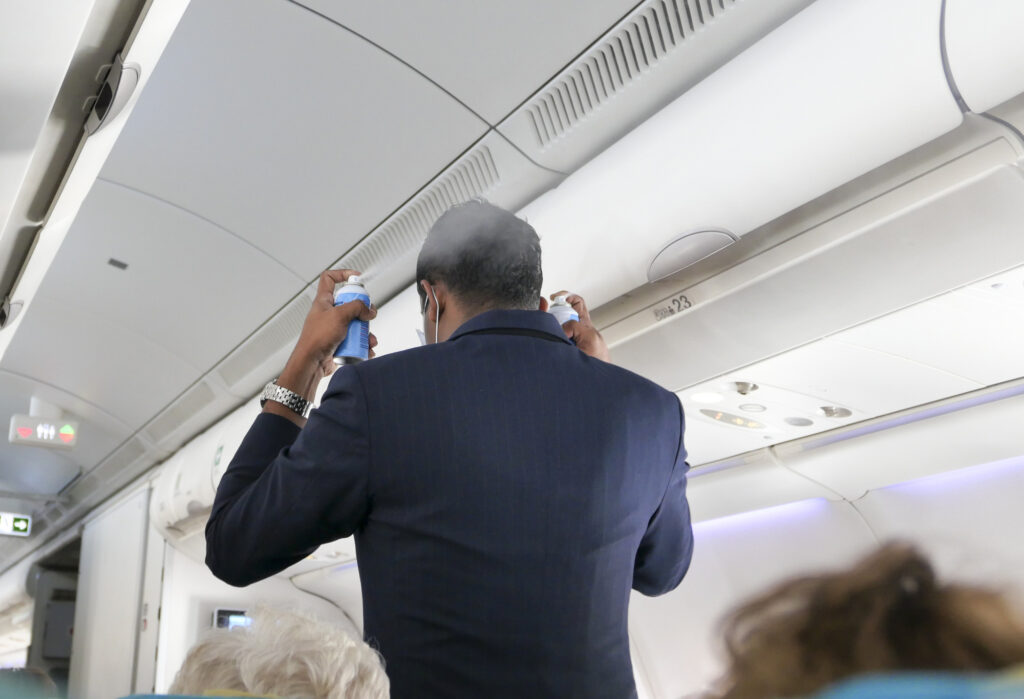
Disinsection requirements are primarily tied to mosquito-borne disease prevention and invasive-species mitigation. They apply to the aircraft, not just the passengers, and they can affect ground time, door procedures, crew responsibilities, and documentation before and after arrival.
Requirements vary significantly by country of origin, previous aircraft operating history, time on ground, and airport-specific enforcement practices. What is accepted at one airport may be rejected at another in the same country.
Italy

Italy is one of the most operationally complex disinsection environments in Europe.
Aircraft operating from Aedes aegypti mosquito-risk regions within the previous 28 days may be subject to mandatory disinsection, written declarations documenting recent operating history, and residual treatment requirements. Acceptance of self-spray procedures varies by airport and local authority and should not be assumed.
Milan Linate (LIML) adds another layer: Japanese beetle mitigation procedures may require aircraft doors to remain mostly closed during designated daytime periods. Operators who are not briefed on this before arrival will find out on the ground, which is the wrong time.
Our blog has full details on Italy disinsection requirements.
Egypt
Egypt maintains strict vector-control procedures for aircraft arriving from designated countries. Requirements may include passenger cabin spraying, baggage compartment treatment, WHO-approved insecticide requirements, and passenger manifest submission. Empty spray containers may be retained for inspection. Non-compliance can result in fines or additional enforcement action.
Malaysia
For international arrivals into Sultan Abdul Aziz Shah Airport (WMSA), operators may encounter residual disinsection requirements, mandatory onboard certificates, and additional treatment verification during arrival inspection. Requirements should be confirmed locally before departure.
China

Chinese authorities implement biosecurity and insect-control procedures tied to certain international arrivals, with particular attention to agricultural and invasive-species concerns. Enforcement posture can vary by origin, airport, and season. Local confirmation before arrival is essential.
Australia
Australia operates one of the most strictly enforced biosecurity regimes in the world. Aircraft arriving from certain origins may be subject to mandatory disinsection using approved methods, cabin and hold treatment documentation, and biosecurity declarations covering food, biological material, and equipment on board. The Australian Department of Agriculture enforces these requirements consistently and penalties for non-compliance are significant.
Why Passenger Travel History Is Also an Operational Variable
Disinsection is an aircraft-level requirement. Passenger screening is a separate layer, and the two can interact in ways that complicate planning.
In several jurisdictions, health screening procedures are tied not to where the aircraft departs from, but where passengers or crew members have recently traveled. A passenger who transited an affected region weeks earlier on a separate itinerary may still trigger additional arrival procedures, screening requirements, or routing considerations.
Before finalizing any international itinerary, operators should verify:
- Passenger and crew travel history and any prior transit through affected countries
- APIS consistency across all legs
- Current arrival procedures and any designated airport requirements at the destination
- Local screening or declaration requirements before departure
- Whether airport-specific health procedures apply to the aircraft itself
Where Operators Run Into Problems
The most consistent pattern across all of these requirements is discovery timing. Operators who encounter problems are usually not unaware that health-related procedures exist. They are unaware that a specific procedure applies to their specific operation until after routing is finalized, APIS is submitted, or the aircraft is on the ground.
- Assuming disinsection procedures are standardized nationally
- Overlooking airport-specific enforcement differences
- Failing to account for passenger travel history before routing decisions are made
- Treating screening or treatment requirements as static when they are operationally dynamic
- Discovering documentation requirements after APIS submission
Planning Takeaway
Health-related compliance is not an outbreak-only concern. Disinsection requirements, vector-control programs, and passenger screening procedures are part of the baseline international operating environment.
The operators who handle this well are not the ones who research it after a problem surfaces. They are the ones who build the verification into the planning process before the trip brief is finalized.
If a mission touches Europe, the Middle East, Asia-Pacific, or any region with active vector-control programs, the question is not whether health-related procedures exist. It is which ones apply to this aircraft, this passenger manifest, and this routing.