


Greek Islands: 2026 Business Aviation Destination Guide
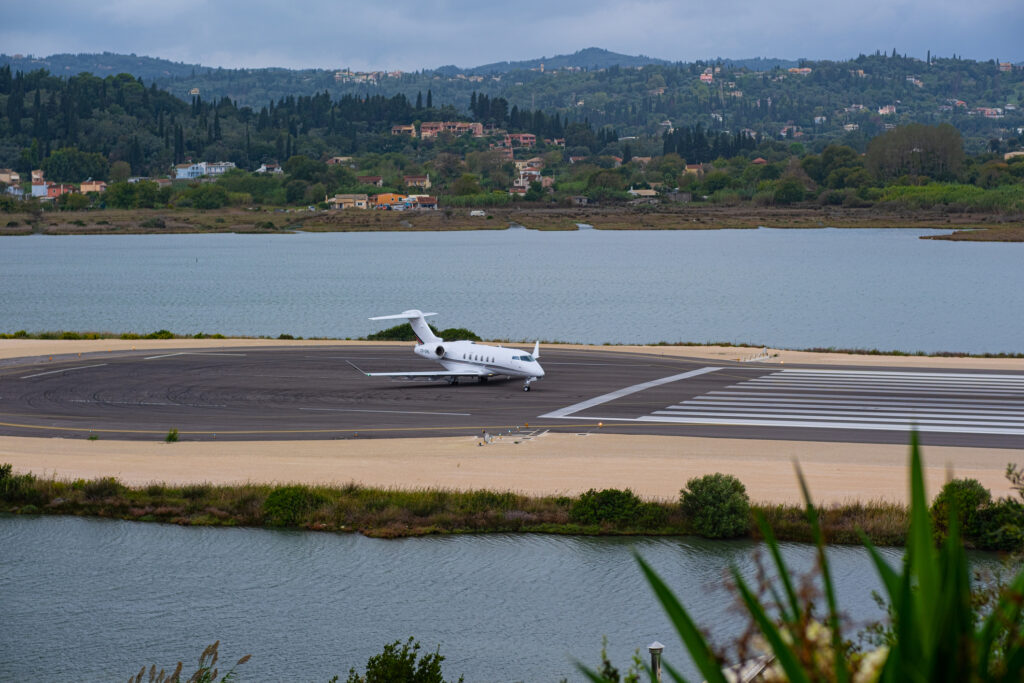
Island airports in Greece are not built around the assumption that the aircraft will stay on the ground. Most itineraries only hold together when drop-and-go and a confirmed reposition are planned from the start, not treated as a fallback once parking gets denied.
That single assumption changes the entire planning chain: parking drives PPR timing, which drives slot eligibility and slot discipline, which affects fuel timing and CIQ flow on the day.
There are no Western-style FBOs at most Greek island airports. There are no GA terminals at the majority of destinations. Passengers clear CIQ alongside commercial traffic in the main terminal. Mykonos (LGMK), Corfu (LGKR), and Kos (LGKO) have small GA lounges that all GA users are required to use, and that model appears to be expanding, but those are the exceptions.
The infrastructure reflects the operating reality: most aircraft arrive, offload, and leave.
“The island isn’t the decision point,” says Dimitra Kiriakopoulou, Ops and Customer Care Director at Universal Aviation Greece. “The decision is where the aircraft is going after. If that’s not confirmed early, the rest of the plan doesn’t hold.”
Drop-and-go with repositioning is the standard operating model in peak season.
The Airports and What They Actually Allow

Primary island and coastal destinations for business aviation in Greece include:
- Santorini (LGSR)
- Mykonos (LGMK)
- Corfu (LGKR)
- Rhodes (LGRP)
- Chania (LGSA)
- Heraklion (LGIR)
- Kefalonia (LGKF)
- Preveza (LGPZ)
- Thessaloniki (LGTS)
- Kalamata (LGKL)
Three of these — Preveza (LGPZ), Kalamata (LGKL), and Chania (LGSA) — are military airports that accept commercial and GA traffic. They operate under specific requirements that break trips when lead time is treated as negotiable.
- Landing permit applications require a minimum four working day lead time for private aircraft
- PPR applications require 48 hours notice for all operations, including commercial ad hoc flights
If you miss the permit clock, you are not late. You are outside the published process.
At Santorini (LGSR) and Mykonos (LGMK), PPR is approved for a maximum stay of 40 minutes between 0500Z and 1800Z at LGSR and 0400Z to 1930Z at LGMK. This is a hard limit during the busiest part of the day.
At Santorini, overnight stays of up to 11 hours are now possible outside that window, but peak season demand means most operations still fall inside the daytime restriction. Treat the 40-minute ceiling as the default planning condition for both airports.
Corfu (LGKR), Preveza (LGPZ), Kalamata (LGKL), Kefalonia (LGKF), and Heraklion (LGIR) do not publish official parking restrictions but operate with local parking procedures. None should be assumed to have overnight parking available during peak season without confirmed PPR.
What breaks here is usually not access. It is the assumption that visible ramp space means a place to stay.
Why Parking Denials Trigger Everything Else
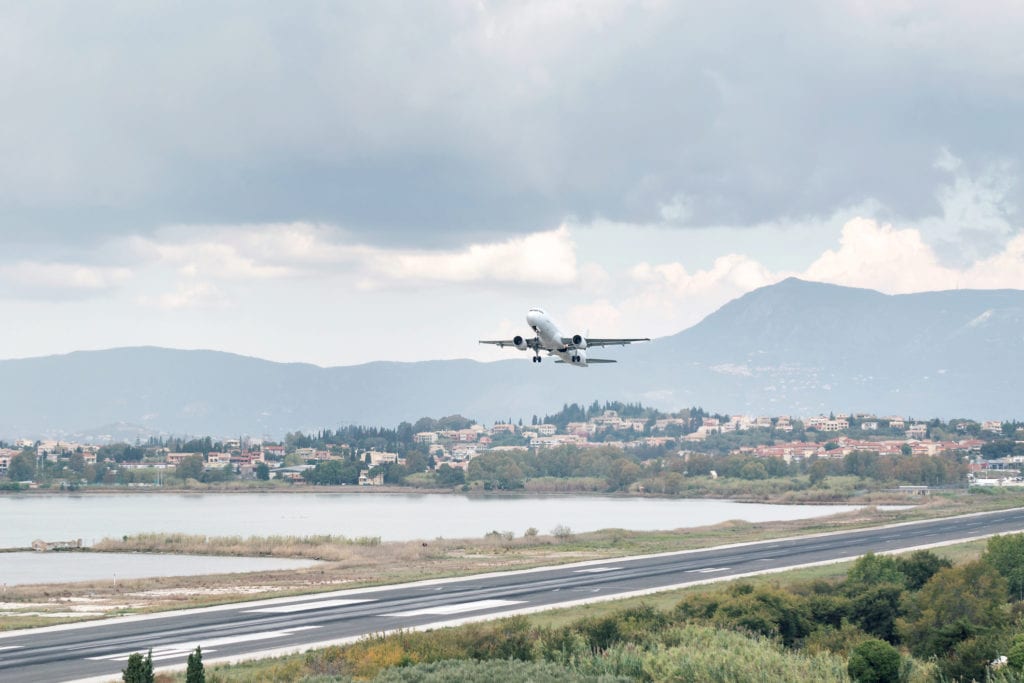
GA aircraft are also competing with commercial airline traffic for limited services and slots during the peak travel season to the Greek Isles.
PPR must be confirmed before slot coordination can begin. The slot request must match the PPR times exactly.
Once PPR is confirmed:
- A 10-digit confirmation number is issued
- That number is entered into the GCR slot request
- The slot ID is entered into Item 18 of the flight plan in ASL format
By regulation, PPR lead time is 14 days, but many airports require a minimum notice of 48 hours, a limitation consistently enforced at several locations.
Do not assume the shorter timeline applies.
Slot deviation tolerance across Greek island airports is plus or minus 15 minutes. Some airports provide only four slots per hour across both airline and GA traffic. During peak demand, preferred times are often unavailable by the time requests are submitted.
Slots may be requested up to 14 days in advance through the OCS.
The national slot coordinator operates:
- Monday through Friday
- 0830–1630 local
- Extended hours during peak season
Commercial operators with OCS access may submit requests on their own, but coordination with the local handler is advised because the request must exactly match the approved PPR.
Slots that will not be used must be canceled at least 12 hours in advance.
Operating without a slot, or outside the approved slot window, can generate penalties ranging from €1,000 to €30,000.
A notice is issued and must be responded to within five days. Authorities then determine whether a fine applies and in what amount. The process runs through the ground handler and can take several months to resolve.
Holding multiple slot bookings without canceling unused ones generates penalty points that may affect future access.
“Once parking isn’t confirmed, everything else starts to move,” Kiriakopoulou says. “Slots, crew timing, reposition. You’re no longer executing a plan, you’re reacting to changes.”
The Failure Chain That Repeats Every Summer
A schedule gets drafted around preferred arrival and departure times. Then the PPR comes back with slightly different approved times or a shorter stay window.
Because slot requests must match PPR times exactly, the operator has to shift the slot request. If the preferred slot is no longer available, the island turn compresses into a tighter operating window.
The aircraft arrives outside the plus or minus 15-minute tolerance, the operation slides, and the plan gets rebuilt in real time around compliance rather than preference.
Typical pattern: LGMK parking not confirmed by Thursday → LGSR already constrained → alternates like LGKR and LGSA fill by Friday → aircraft forced into suboptimal reposition with slot misalignment.
Lock PPR first. Then request matching slots. Then build crew, fuel, and CIQ timing around those approvals.
Why Repositioning Is the Real Plan
Once the aircraft drops passengers, it needs a confirmed place to park.
Thessaloniki (LGTS), Chania (LGSA), and Kos (LGKO) remain the primary reposition options depending on the island cluster involved. Each carries its own slot and parking dynamics.
The reposition airport needs to be confirmed before the aircraft departs for the island.
The failure point is not the island stop. It is leaving reposition confirmation to the last minute.
Once the aircraft is on the ground at the island with passengers off and no confirmed reposition, the schedule starts chasing parking. Slots at both ends fall out of alignment and the operation begins consuming compliance margin with no plan underneath it.
“Reposition isn’t a fallback in Greece,” Kiriakopoulou says. “It’s the part of the operation that needs to be certain before anything else moves.”