


eu-LISA Carrier Validation Requirement Takes Effect April 10, 2026 for Schengen Flights
Impact Summary
- Beginning April 10, 2026, the European Union will require carriers to electronically verify passenger travel authorization prior to departure for flights entering the Schengen Area.
- The requirement is managed through the eu-LISA carrier interface and shifts part of the responsibility for verifying travel eligibility from border authorities to operators.
- Business aviation operators conducting flights into the Schengen Area from outside the region should prepare now by completing carrier registration and establishing submission procedures.
EU Introduces eu-LISA Passenger Validation Requirement for Flights to Schengen
The European Union is implementing a new passenger verification requirement that will affect operators conducting international flights into the Schengen Area.
Beginning April 10, 2026, carriers will be required to electronically verify traveler authorization prior to departure using the eu-LISA carrier interface. The requirement is part of a broader modernization of EU border systems and will introduce new operational responsibilities for operators transporting passengers to Europe.
Although early discussion focused primarily on commercial airlines, the definition of “carrier” used by the system is broad and may apply to business aviation operations as well.
Operators planning flights to the Schengen Area should begin reviewing procedures and registration requirements now to ensure compliance before the mandatory deadline.
Implementation Timeline
The EU has implemented a phased rollout of the systems managed by eu-LISA.
- Voluntary participation period: January 9 – April 9, 2026
- Mandatory carrier participation: April 10, 2026
- ETIAS implementation: Expected October 2026
The voluntary period allows operators to prepare for compliance prior to full enforcement beginning in April.
What is eu-LISA?
eu-LISA is the European Union Agency responsible for managing large-scale IT systems supporting border management and traveler screening across the Schengen Area.
Through its carrier interface, operators must verify whether passengers have valid travel authorization before boarding for flights entering the Schengen Area from outside the region.
This system checks traveler information against EU border management databases and returns a validation response prior to departure.
Systems Managed by eu-LISA
Two systems managed by eu-LISA will directly impact operations.
Entry/Exit System (EES)
The Entry/Exit System replaces traditional passport stamping with biometric and electronic records.
For operators, this means the system can verify:
- Whether a traveler’s short-stay visa remains valid
- Whether the number of permitted entries has already been used
EES tracks entry, exit, and overstay status for third-country nationals traveling to the Schengen Area.
European Travel Information and Authorization System (ETIAS)
ETIAS will require visa-exempt travelers to obtain electronic authorization prior to entering the Schengen Area.
The system functions similarly to the U.S. ESTA program and is expected to become operational in October 2026.
Once implemented, carriers will be required to verify that visa-exempt passengers hold a valid ETIAS authorization prior to departure.
What the Carrier Interface Verifies
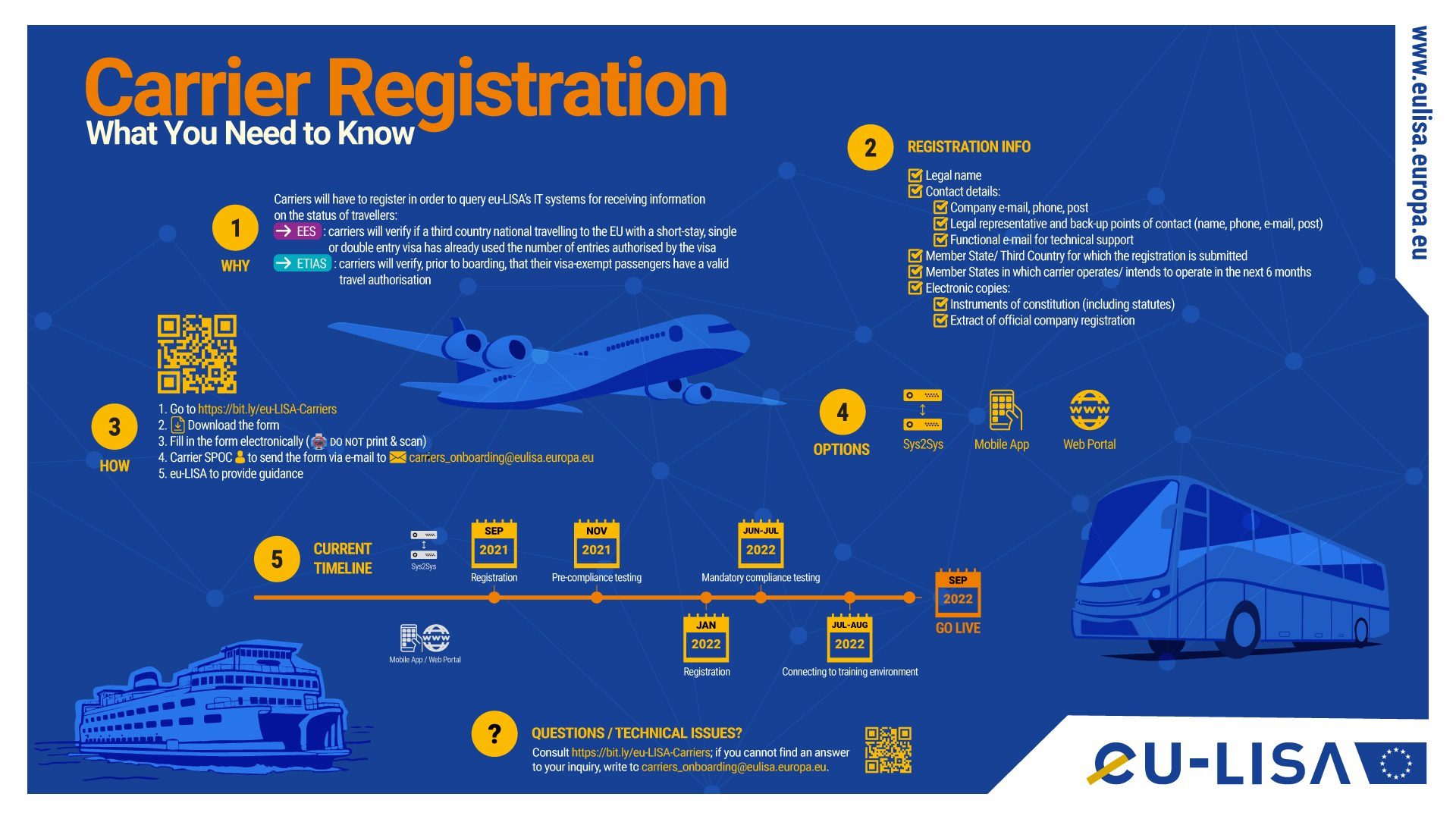
When passenger data is submitted through the eu-LISA carrier interface, the system checks whether:
- A traveler’s short-stay visa remains valid
- The number of permitted entries on the visa has already been used
- The traveler holds a valid ETIAS authorization once ETIAS becomes active
The system returns either an OK or NOT OK response based on the available data.
Important: eu-LISA Is Not an APIS Clearance
The eu-LISA validation system should not be confused with Advance Passenger Information System (APIS) submissions.
Unlike APIS, the carrier interface does not issue a clearance to operate. Instead, it provides a pre-departure validation of travel documents.
Operationally, this means:
- Submissions may be made anytime up to 48 hours prior to departure
- A response does not represent permission to operate
- Flights generally do not need to be delayed if a passenger is added close to departure
The requirement applies only to flights entering the Schengen Area from outside the region. It does not apply to intra-Schengen flights or flights departing the Schengen Area.
Understanding “OK” and “NOT OK” Responses
When traveler information is submitted through the carrier interface, the system returns one of two responses.
An OK response indicates that no issues were identified based on the available visa or ETIAS data.
A NOT OK response does not automatically mean that a traveler will be denied entry.
The system only checks short-stay visas electronically linked to the passport. It cannot identify several other valid travel documents, including:
- EU residence permits or residence cards
- Long-stay visas
- Diplomatic passports
- Laissez-passer travel documents
- Transit passengers continuing to destinations outside the Schengen Area
Operators must confirm whether a traveler holds another valid entry document before making boarding decisions.
If a traveler arrives without valid authorization, the carrier may be responsible for returning the passenger to their point of origin and could face penalties.
Applicability to Business Aviation
While early regulatory discussions appeared focused on commercial airlines, eu-LISA has not formally excluded private flights from the definition of a carrier.
The system defines a carrier as:
“Any natural or legal person whose occupation it is to provide passenger transport by air, sea, or land.”
Based on this definition and the level of scrutiny typically applied to business aviation operations in Europe, operators conducting flights into the Schengen Area should expect to be treated as carriers.
Universal recommends that flight departments operating to Europe register with eu-LISA to ensure compliance.
Carrier Registration Requirements
Operators must register as a carrier before they can access the eu-LISA carrier interface.
Registration typically requires submission of documentation including:
- Designated organizational points of contact
- Business registration documentation such as articles of incorporation or business license
- Air Operator Certificate, if applicable
- Declaration of the intended method of access to the carrier interface
Once registration is approved, the operator receives a unique carrier identification code that is used in manifest submissions.
Even when a third-party service provider submits traveler data, the operator must maintain ownership of the carrier account.
What Operators Should Do Now
Operators conducting flights into the Schengen Area should begin preparing for the April 10 implementation date.
Recommended steps include:
- Confirm whether your operation conducts flights into the Schengen Area from outside the region
- Begin the eu-LISA carrier registration process early to avoid delays
- Establish internal ownership of the carrier account even if a service provider submits manifests
- Monitor updates related to EES and ETIAS as timelines and procedures continue to evolve
Preparing early will help avoid operational disruptions once the requirement becomes mandatory.
How Universal Weather Supports eu-LISA Compliance
Universal Weather now supports eu-LISA passenger validation as part of our trip support services.
For operators that have completed carrier registration, our team can submit passenger manifest data through the eu-LISA carrier interface and return validation results prior to departure.
If a traveler returns a NOT OK response, operators are notified so travel documentation can be reviewed before boarding.
Universal also provides assistance with the carrier registration process for operators that have not yet registered with the eu-LISA network.
Operators planning upcoming flights to the Schengen Area are encouraged to begin preparations now to ensure readiness ahead of the April 10, 2026 compliance date.
If you want assistance, we can help. Visit our website.
More Information
For further details on eu-LISA, EES, and ETIAS, refer to the following official resources:
-
Revised EES and ETIAS Implementation Timeline (March 2025 Update):
https://travel-europe.europa.eu/revised-timeline-ees-and-etias-2025-03-07_en -
Official eu-LISA Website:
https://www.eulisa.europa.eu/ -
Entry/Exit System (EES) Overview:
https://travel-europe.europa.eu/ees_en -
European Travel Information and Authorization System (ETIAS) Overview:
https://travel-europe.europa.eu/etias_en